
Jiashuo Zhang
张家硕
Baltimore, MD, USA
About Me
I am a Research Assistant at Johns Hopkins University, advised by Prof. Michael Oberst. I also work part-time as a Machine Learning Engineer at Visilant Inc. I’m primarily interested in how AI can be applied to the biomedical and healthcare sectors. 🤖🧬🏥
I received my M.S. in Computer Science from  Johns Hopkins University, where I was fortuned to be advised by Prof. Michael Oberst from the Department of Computer Science and Prof. Kunal Parikh from the School of Medicine. I am also privileged to collaborate with Prof. Liang Zhao from Emory University and Prof. Xiaofeng Yang from University of Chicago.
Prior to that, I completed my B.E. with honors in Software Engineering from  Shandong University, under the supervision of Prof. Leyi Wei, working on bioinformatics research.
Publications & Preprints
-
arXiv
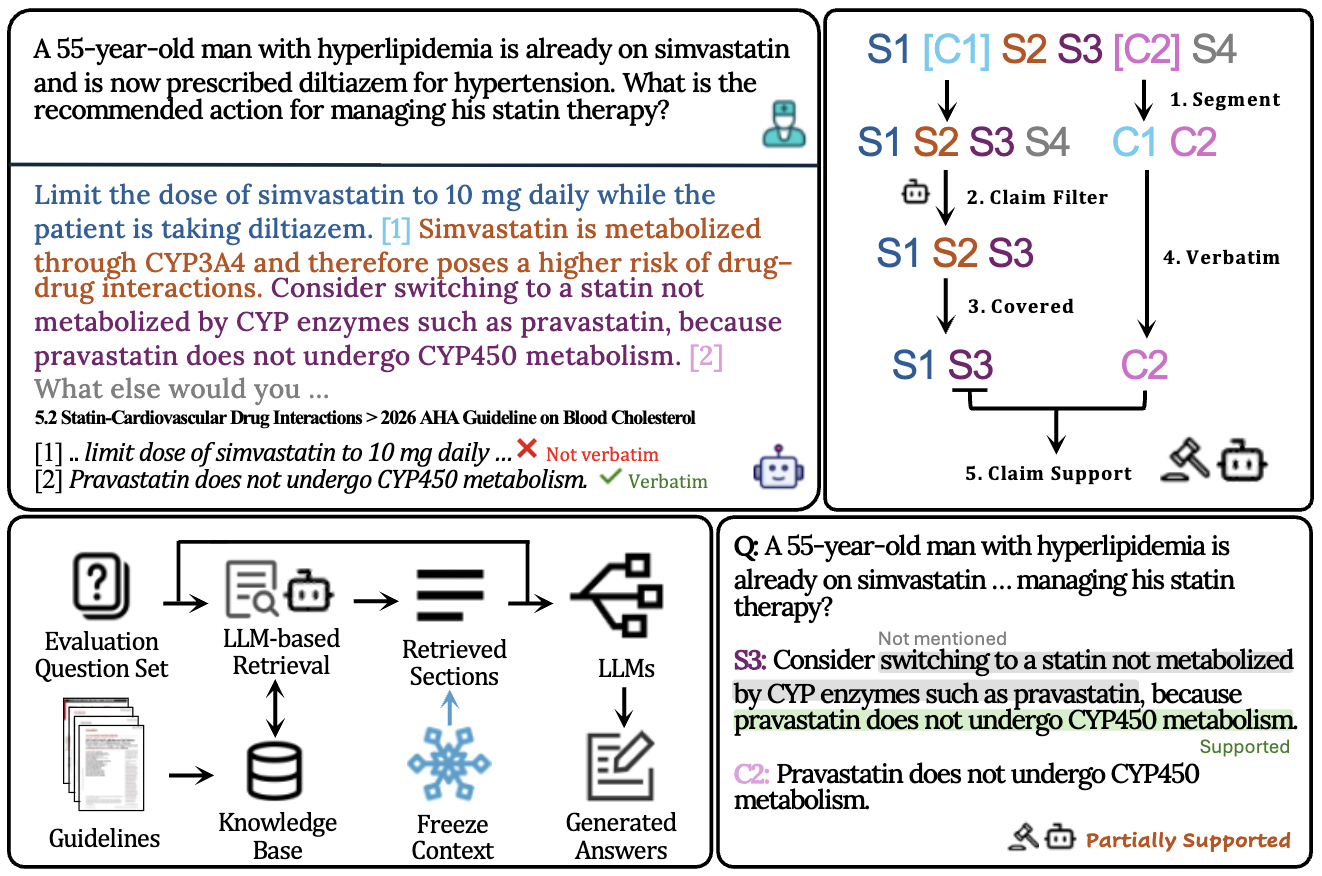 arXiv preprint · 2026This work builds a standardized harness over four clinical practice guidelines and evaluates twelve LLMs on 222 synthetic clinical questions, finding that most models can attach verbatim quotes to over 90% of their claims from prompting alone, apart from some lightweight models such as claude-haiku-4.5.
-
CHIL
 The 7th Annual Conference on Health, Inference, and Learning · 2026Clinical context is used to provide a more holistic evaluation of models for CXR diagnosis, and it is demonstrated that performance degrades when the correlation is broken between prior context and the current CXR label, suggesting that model performance is highly sensitive to the underlying distribution of clinical context.
-
arXiv
 arXiv preprint · 2025An Explainable Cross-Disease Reasoning Framework for cardiovascular risk assessment from LDCT is proposed, which provides an auditable approach to cross-disease cardiovascular risk assessment from LDCT.
-
JCIM
 MucLiPred: Multi-Level Contrastive Learning for Predicting Nucleic Acid Binding Residues of ProteinsJournal of Chemical Information and Modeling · 2024A novel deep learning model equipped with a dual contrastive learning mechanism aimed at improving the prediction of multiple molecule-protein interactions and the identification of potential molecule-binding residues, which represents a significant advancement in protein-molecule interaction prediction.
Industry

|
Visilant Feb. 2026 – Present · Baltimore, MD Machine Learning Engineer · Part-time |

|
Bosch Nov. 2023 – Mar. 2024 · Suzhou, China Software Engineer · Internship
Bosch Connected Industry, Engineering Software.BCI/ESW1-CN Team.
|
Education

|
Johns Hopkins University Aug. 2024 – Dec. 2025 · Baltimore, MD Master of Science · Computer Science
GPA: 3.96 / 4.0
Courses: Machine Learning for Healthcare, Machine Learning: Deep Learning, Computer Vision, Vision as Bayesian Inference, Software System Design, etc.
|

|
Shandong University Sept. 2020 – June 2024 · Jinan, China Bachelor of Engineering · Software Engineering
GPA: 89.29 / 100
Courses: Data Structures, Operating System, Computer Networks, Database System, Organization and Structure of Computer, Algorithm Design and Analysis, etc.
|
Presentations & Talks
-
Development and Evaluation of an AI Agent to Augment Multidisciplinary Care Teams in Shared Decision-Making for Improving Cardiovascular Health2026 Welch Center Research Day · Poster
-
Guideline and Evidence-Based Shared Decision-Making: Healthcare Knowledge Q&A SystemThe 9th Annual Johns Hopkins Research Symposium on Engineering in Healthcare · Poster
Services
- Reviewer · ML4H 2026
- Volunteer · MLHC 2026
Honors & Awards
-
Bachelor's Degree with Honors · Shandong University, 2024
Awarded to 14 of 476 graduates in the School of Software, Class of 2024. - Academic Scholarship · Shandong University, 2021 & 2022
Powered by Jekyll and Minimal Light theme.
Trouble viewing? Open the PDF in a new tab.